
You send the documents. The Hub builds itself.
A family’s whole financial life, built out of the paperwork you already hold, in under five minutes, then kept current between meetings without you. Below is why that matters, and then the demonstration we give on a call, in the same order. Every screen is the working product.
Right now it is all in a cabinet in the study.
The study, the folders, the home computer
Nearly every family has one: a room where the paperwork lives, understood by one or two people and by nobody else. It works right up until the person who understood it is not there to explain it.
A vault tidies the drawer. It does not move the dial.
Storage is an admin function. It files what you already had, in the order you already had it. Nothing is joined up, nothing is being watched, and nobody learns anything.
And you are advising half a family
Nine times in ten you sit with mum and dad, or with one of them, while trying to steer wealth through an entire family and a tax code that changes every year. The people the money is actually going to are not in the room, and their circumstances, their needs and their generation are guesswork.
From a folder of documents to a family’s own website.
1 · Add the family
A name, the main client, an email address. That is the entire form. If your firm runs Intelliflo, pick them out of your book instead and the form fills itself in.
2 · Send up what you already hold
Fact finds, suitability letters, statements, valuations, policy schedules, wills, trust deeds. Any order, any format: PDFs, scans, photographs of paper, Word and Excel. The digital companion reads each one as it lands and works out what it is. You do not sort them first.
3 · Check the reading, and sign it off
The companion lays out everything it found, the family, money and records, wills and legacy, trusts, the household and its providers, with the document each line came from. You edit, delete or confirm. Where a document was ambiguous it does not guess: it leaves the item out and asks you, and you answer in a tap or in your own words. Nothing reaches the family until you say so.
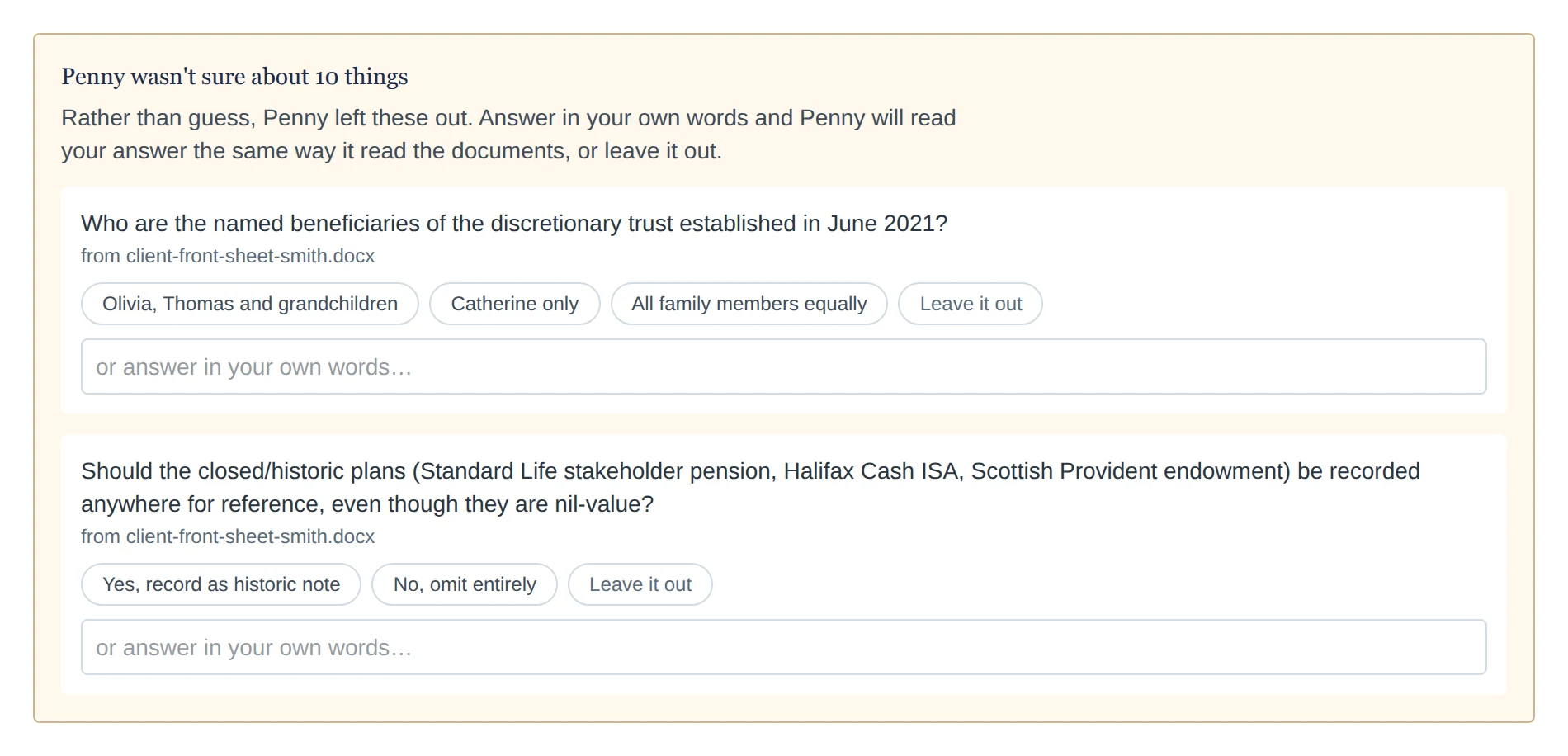
It asks rather than guesses
Where the paperwork was ambiguous, you get a question, not a guess
The companion is not allowed to invent a figure. When a statement is unclear about who owns what, or a valuation carries two dates, the item is left out and the question comes to you with the document that raised it. Answer in a tap, answer in your own words, or leave it out. This is the answer to the first question your compliance officer will ask.
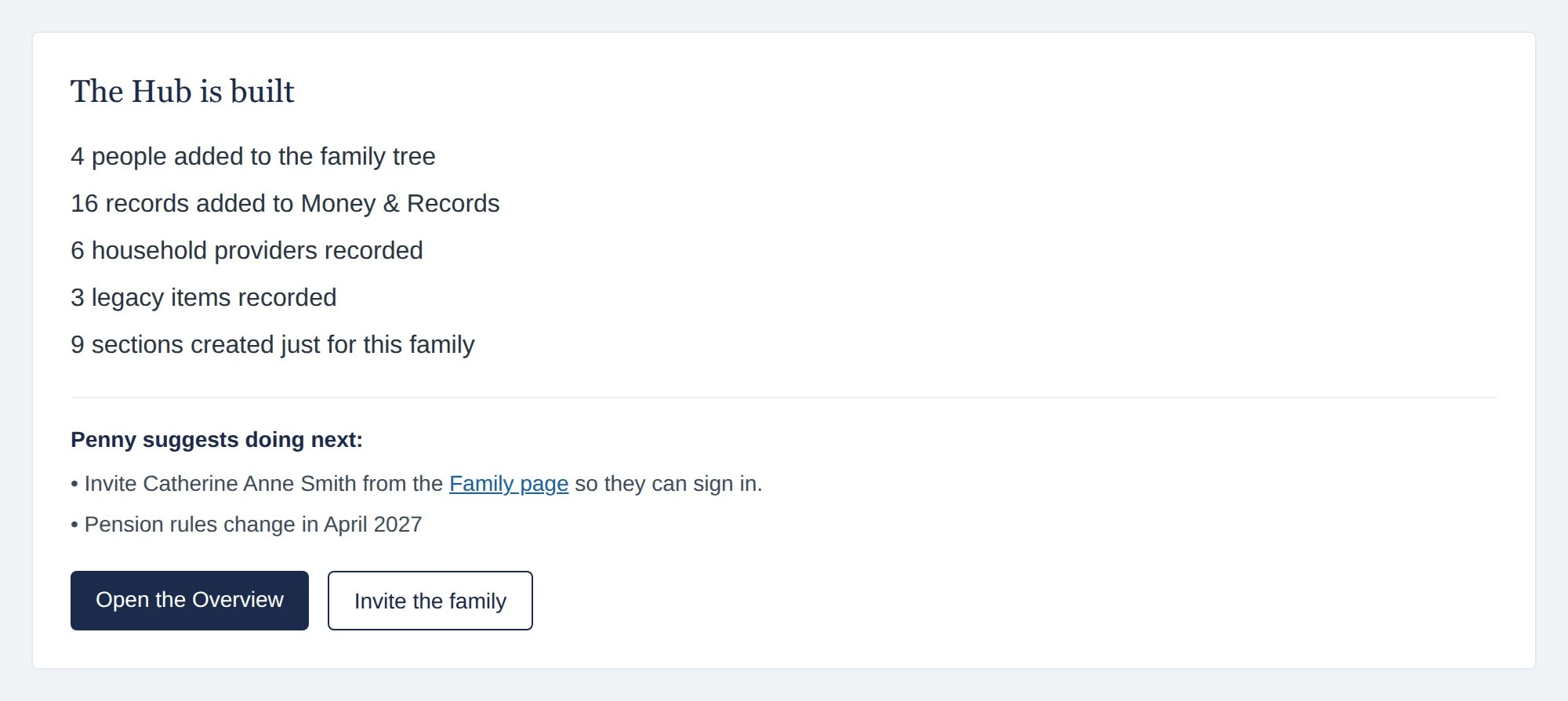
Counted back to you
The Hub is built, and it already knows what is missing
People added to the family tree, records in Money and Records, legacy items, household providers, and the sections it created just for this family because their paperwork asked for them. Underneath, what to do next: invite the second holder, and the changes it has already flagged, like the pension rules moving in April 2027. Then you invite the family, and they sign in to a financial life that is already complete.
Five minutes later, this is what they open.
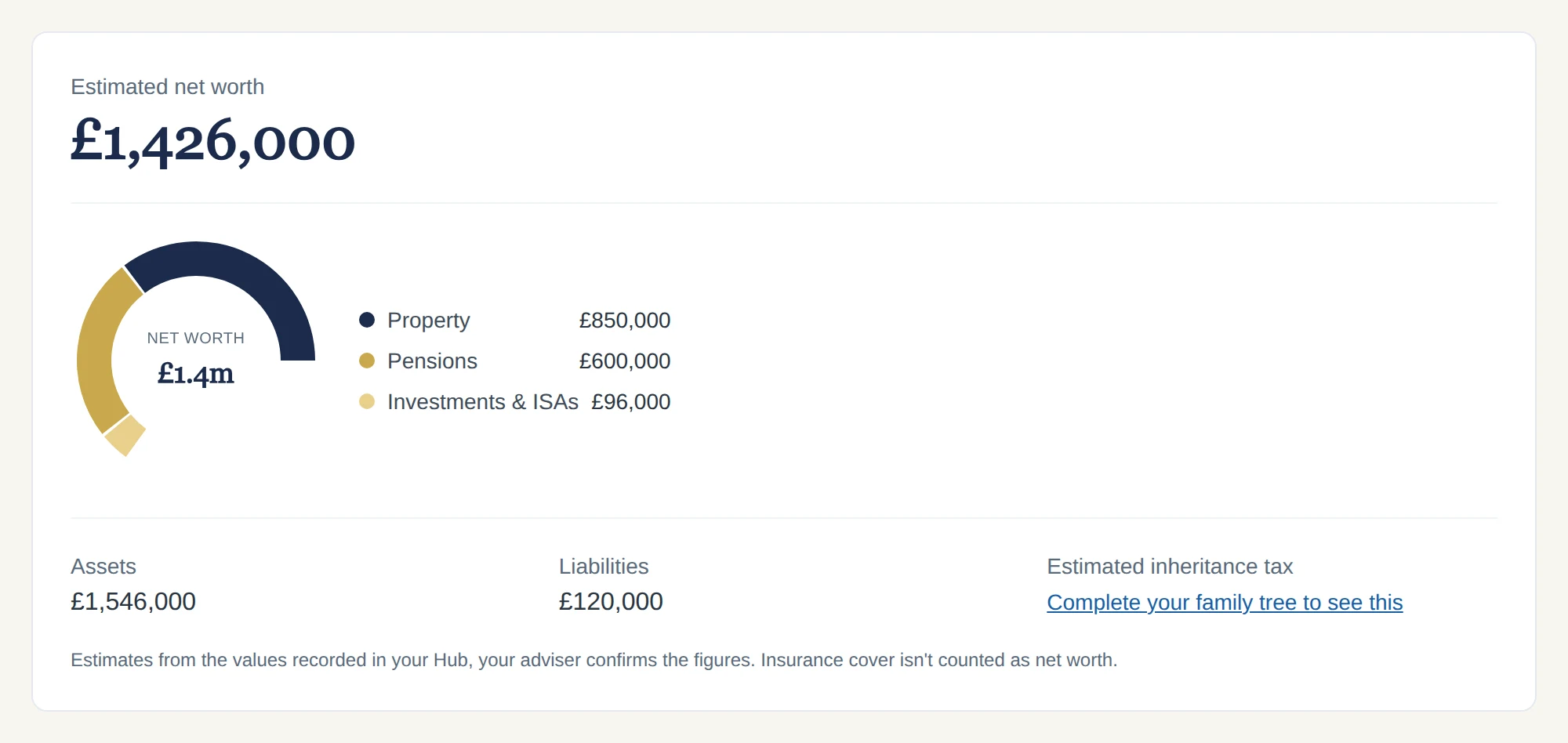
What the family sees
Everything is already there
Robert and Margaret sign in and their whole financial world is waiting: property, pensions, investments and what they owe, built from the documents you sent up and confirmed by you. Nothing to set up, nothing to type in, no forms to chase. What they feel is that you have already done the work, and you have.
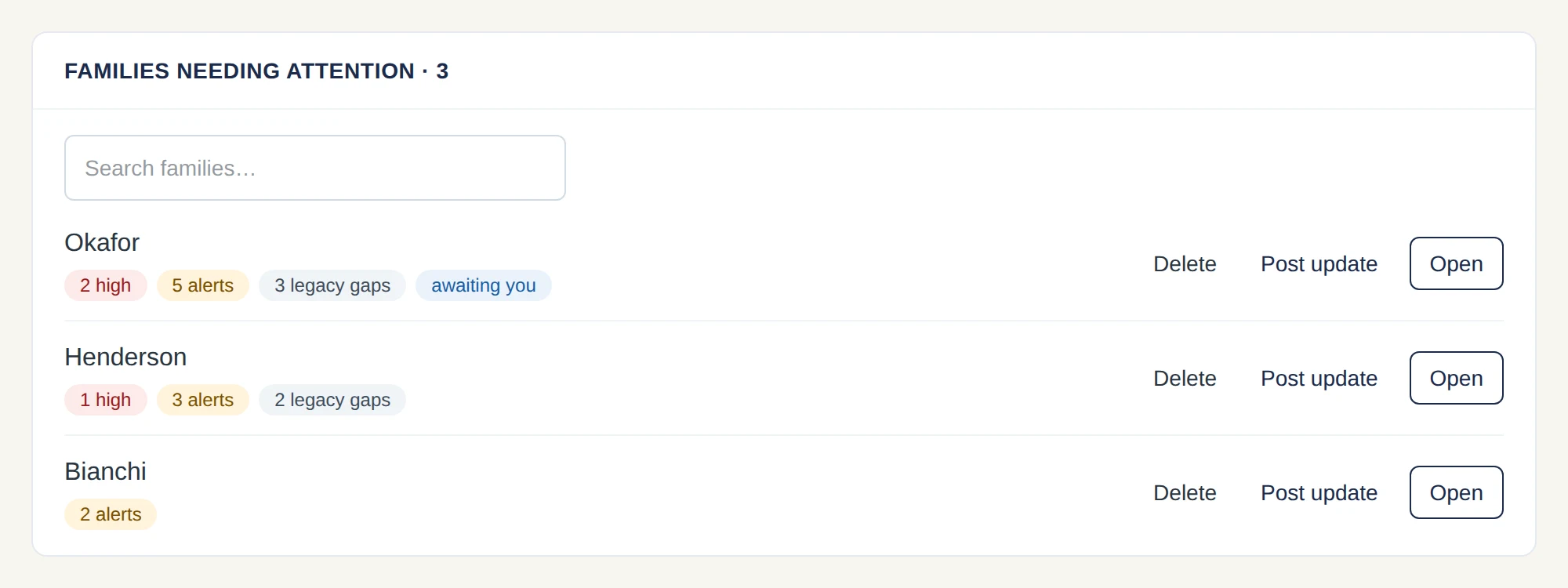
What you see
Your whole book, and where it needs you
Every family you look after on one screen, with open alerts and legacy gaps counted against each one, so you stop guessing who to call. Underneath sit the planning opportunities the companion has spotted across the book: pensions you do not manage, allowances nobody has used, nominations that have gone stale.
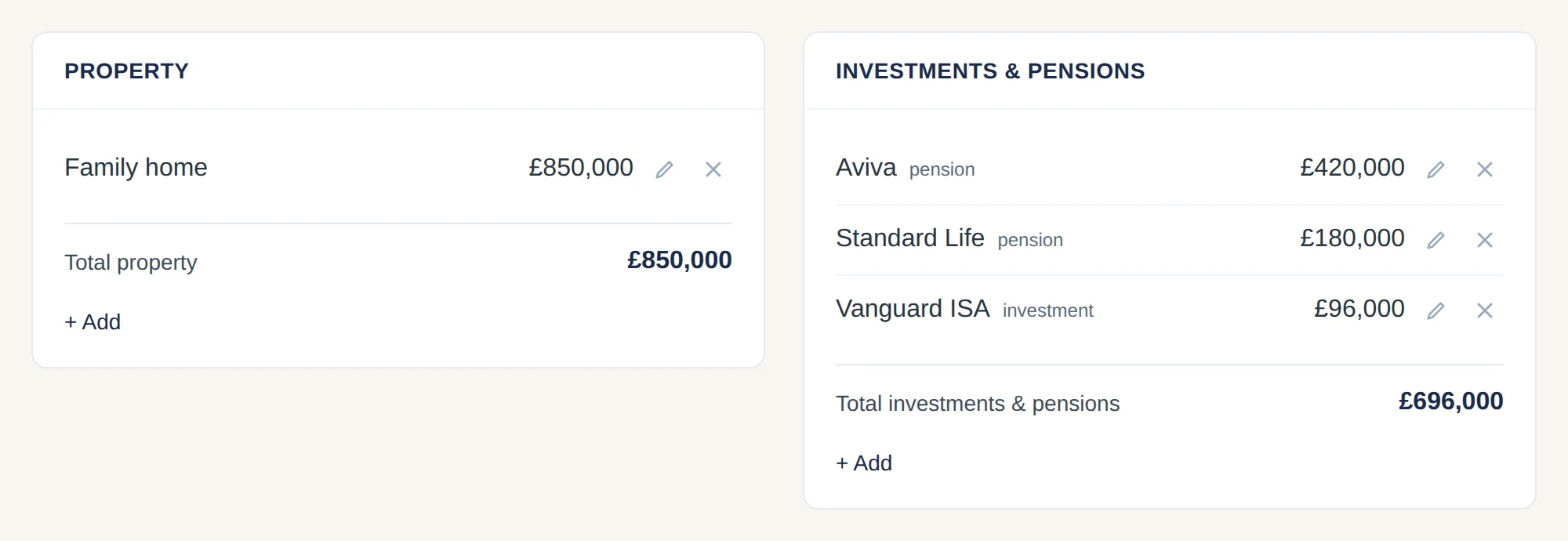
The full record
Not a summary. The full picture.
Property, pensions, ISAs, protection, mortgages and the providers behind them, held in one place and kept current so nothing has to be hunted down later. Every figure is worked out by code from the family’s own records. The AI writes the language, never the numbers.
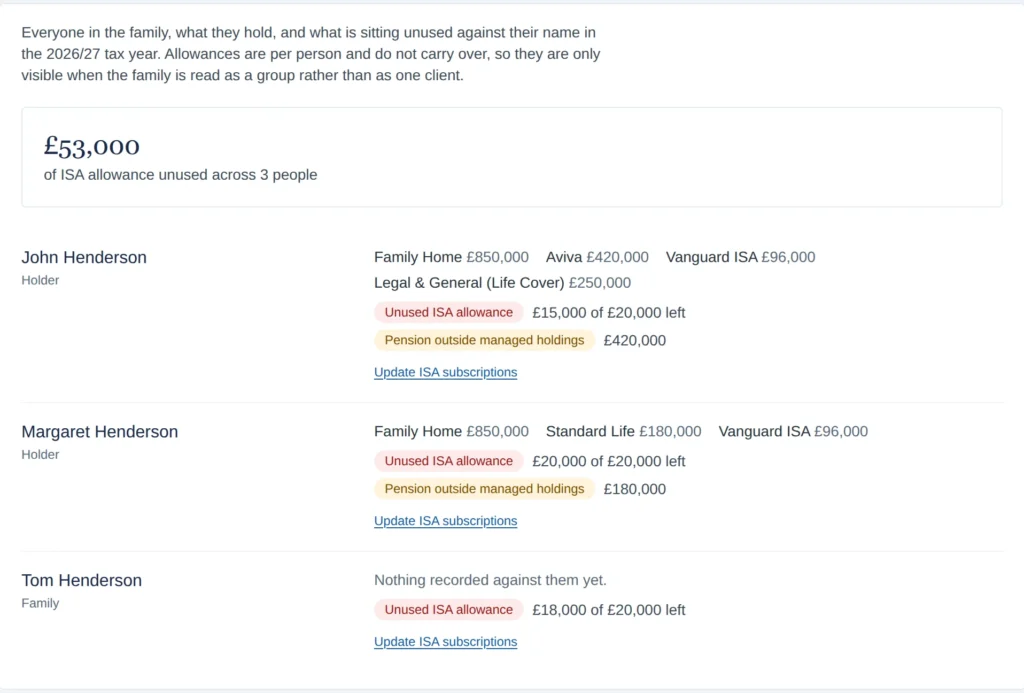
Dynamic planning
A family is not one client. It’s ten.
Look at a family properly, parents, children, their partners, grandchildren, and the numbers change completely. Unused ISA allowances sitting in three or four people’s names, never coordinated because nobody has ever seen them side by side. Pension contributions that could be timed around each other, but are not, because nobody is structured to look. Gifting that could reduce a future tax bill, left undone because it was never anyone’s specific job to raise it.
Accountants have known this for decades about companies: structure beats fragmentation, every time. Nobody has ever applied the same thinking to a family. There has never been a place to see a family as one connected financial unit, so most of what is sitting there stays invisible, family after family, indefinitely.
This is not hypothetical. It is usually there, in real families, the moment you actually look.
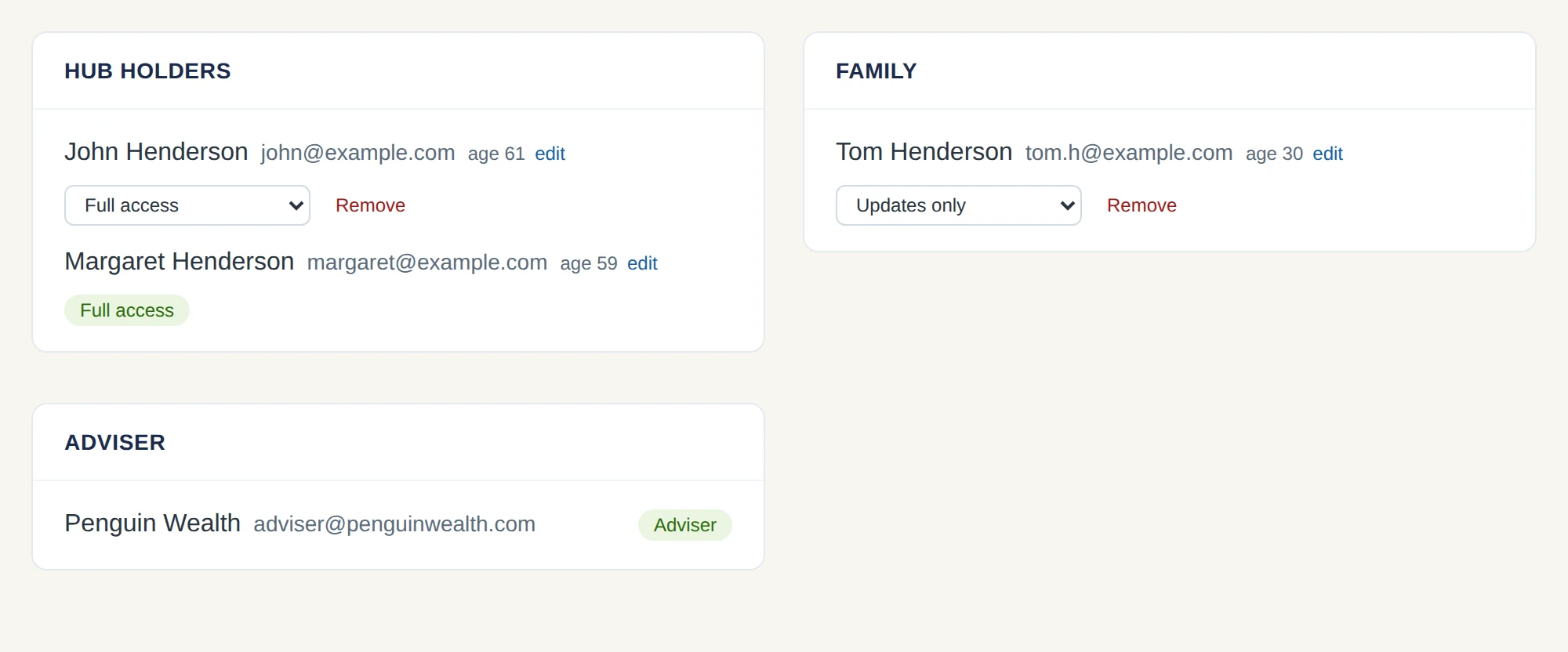
Who sees what
Everyone who matters, at the level you decide
The children get a login years before they inherit. You decide what each person sees: full access, updates only, documents only, or adviser. A solicitor, accountant or executor can be given a seat without being handed control. It moves with the family and stays as open or as closed as they want it, and it is how the next generation meets you at thirty rather than when the estate is being wound up.
You are not buying software. You are hiring.
The part that puts people off is the part that matters.
One team member handling that much complexity, at that volume, sounds preposterous. It sounds preposterous because for the whole of your career it would have been. That is the shift, and the firms that get comfortable with it first are the ones who will be able to grow without their back office growing with them.
What five minutes of your time is worth to the firm.
The next generation already knows you
The generation that inherits usually leaves. These children have had a login for years, read your updates and watched your firm’s films. When the wealth moves, you are not a stranger holding a business card, you are the firm they grew up with.
Growth without the back office growing with it
Every step up the expansion ladder has cost you compliance, paperwork and legwork, which is why most firms stop climbing. The team member absorbs the co-ordination, so how many families you can look after properly stops being set by how much admin you can survive.
Assets you are not managing, out of paperwork you already hold
The build reads everything, not only the pots you advise on. An old workplace pension, protection written by a previous adviser, a property nobody mentioned. Found inside families you already serve, on the day you set them up.
Consumer Duty evidence, as a by-product
Power of attorney gaps, care planning, vulnerability, and what the family was told and when, logged as it happens in an audit trail nobody can edit. Not a separate exercise every December.
It does not touch your back office
This is not a replacement for the systems you run on and does not want to be one. It sits where co-ordination, planning, record keeping and education happen, which is the part those systems were never built for. Nothing has to be ripped out.
The AI never touches a number
Every figure is computed by code from the family’s own records. The companion proposes language and flags what is missing; you sign it off. Nothing it produces reaches a client without an adviser confirming it first.
It carries your name, not ours
Your firm’s brand, on your firm’s address, with a digital companion your firm names: Penguin Wealth call theirs Penny, and yours can be called whatever you like. Families never see a third-party app sitting between you and them.
Three moments that decide whether the assets stay.
Year one
You set them up in five minutes
The documents go up, you sign off what the companion read, and Robert and Margaret open a Hub that is already complete. The children get a login too. They cannot see the detail yet, but they know it exists, and they know who you are.
Year two
Something missing is found
The companion has been watching. Power of attorney is not in place for either of them. You raise it at the family meeting, the solicitor is already in the Hub, and the instruction goes out that week. A crisis is averted five years before it would have happened.
Year seven
Everything is ready
Robert passes away. Nothing has to be found. The will is located, every account and policy is listed, power of attorney is in place for Margaret. The children have read your updates for seven years. The assets stay, and a new generation of clients begins.
Meet the team member.
It has a job description, a name your firm chooses, and a page of its own. Here is what it does between your meetings.
Your Family Financial Hub is a product of Independent Check Ltd · info@independentcheck.co.uk
Not a financial promotion. Does not constitute regulated investment advice.